
Business requirement
The financial dimension is usually a tricky topic during the implementation because the proper allocation during the process affect the accuracy of the cost accounting report. Typically, more complex the business model is, and more structured the allocation roles become.
One of the tools at the disposition of D365FO to handle the financial dimension allocation is the derived dimension. Let’s introduce this example: Imagine you want to attribute a “cost center” on an invoice line, but this value depend on another attribute: For example, for department 023, we want to use the cost center 009. How can we do?
Architectural solution
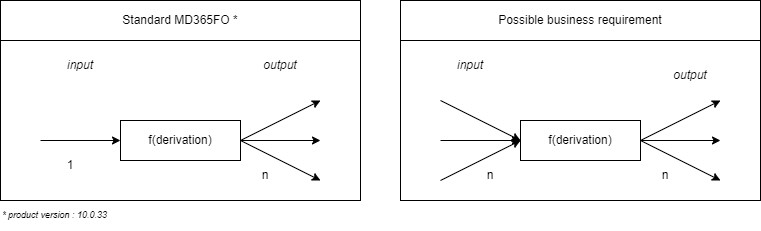
The derivation is a simple input/output function. As input, we have to insert a financial dimension value, that then system process a pre-configurated mapping to give as output an another financial dimension value as output (derived).
The standard enable a mapping from one financial dimension as input. However, if for some reason we would like a derivation from a combinaison of several financial dimension, that’s become a custom.
Configuration
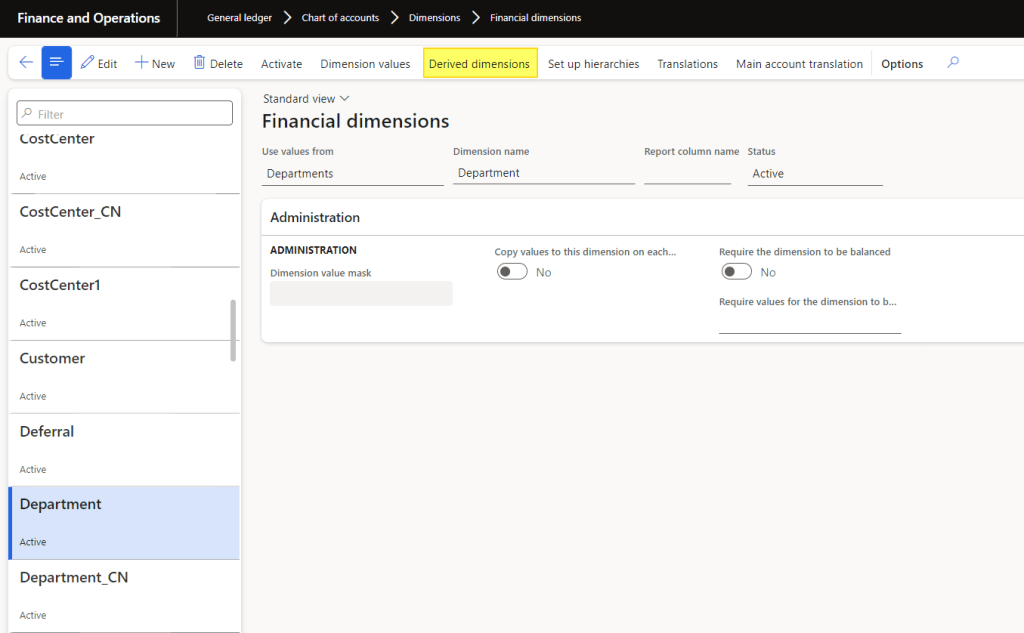
Go to: General ledger > Chart of accounts > Dimensions > Financial dimensions.
Select your input financial dimension and click on “derived dimensions”
The first column is the input value, and the others are the financial dimension derived. Press the “(1) add segment” button to add a new financial dimensiont. On the contrary, if you want to delete, select your column and press ” (2) delete”.
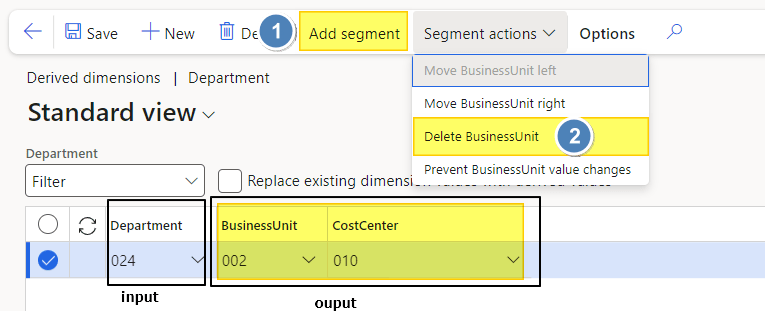
Note: Pay attention even on these last two parameters:
- Prevent changes to derived value: It means that the user cannot change the financial dimension manually on the entry (sales order, purchase order, and general journal)
- Replace existing dimension: if MD365FO already found a value inserted by the user , it’s going to overwrite the value with which on derived.
Process
Case: Manual entry
During the manual entry of a general journal D365FO will derive the financial dimension. It will derive the financial dimension on the header if you put the drive value on the header level or the line level if you insert the value on the line level.
The trigger happens when we insert the value for the first time. If, for some reason, you delete it and save it again, the derivated value is not recalculated.
Case: Inheriting master data entry
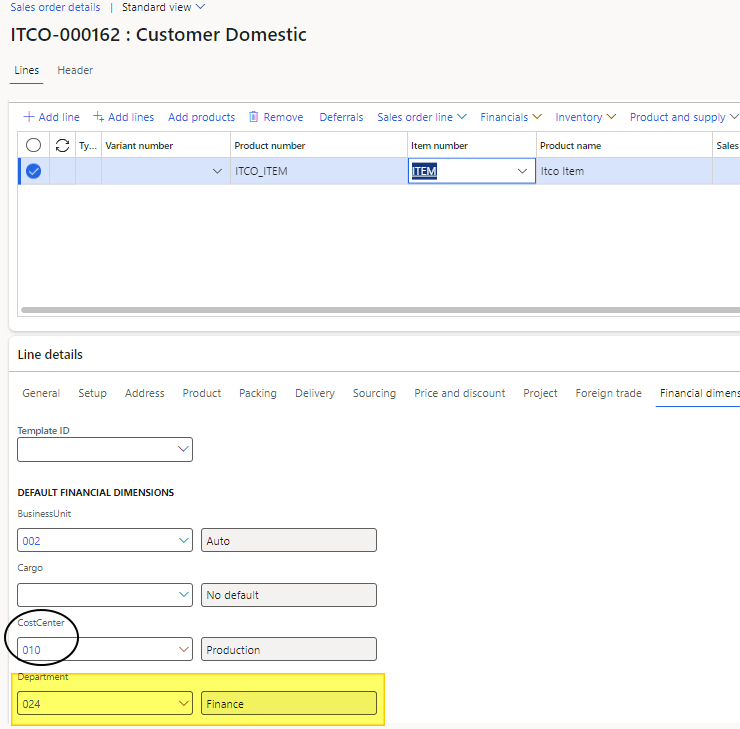
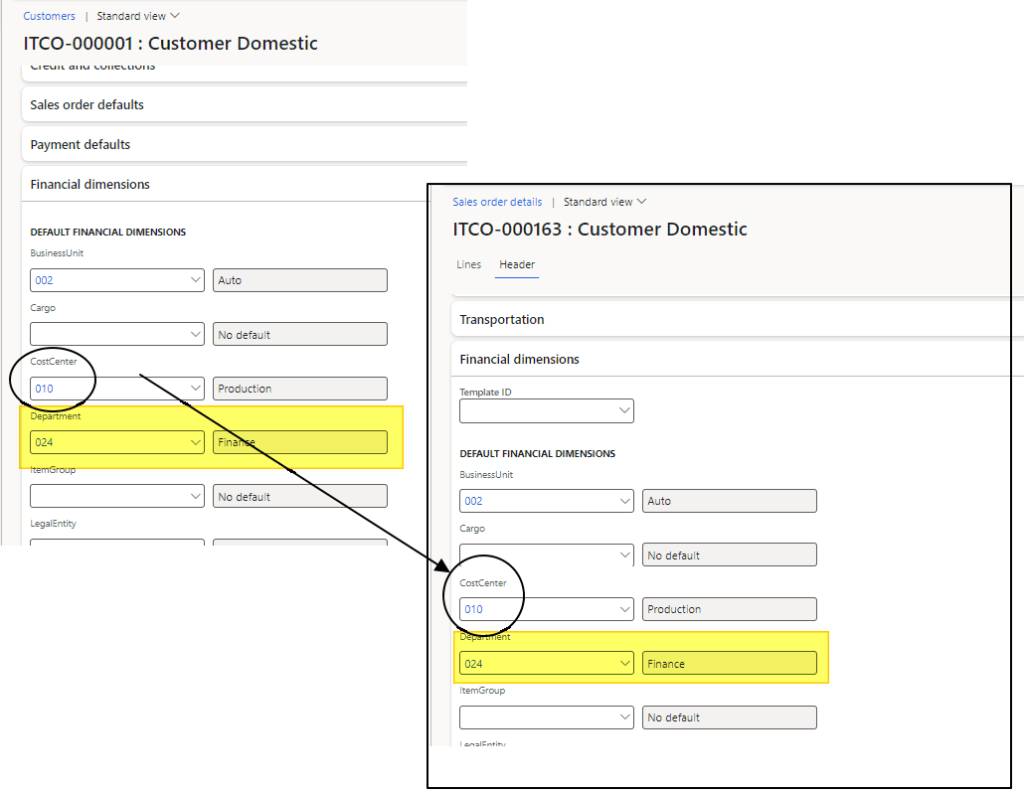
The system derives the financial dimension when we give the driver value on the master data (customer, vendor, items, etc..). Then, all the values are inherited when we create your transaction.
The trigger happens when we insert the value for the first time. If, for some reason, you delete it and save it again, the derivated value is not recalculated.

 Dax365FO
Leave a comment